
READ Learning Center
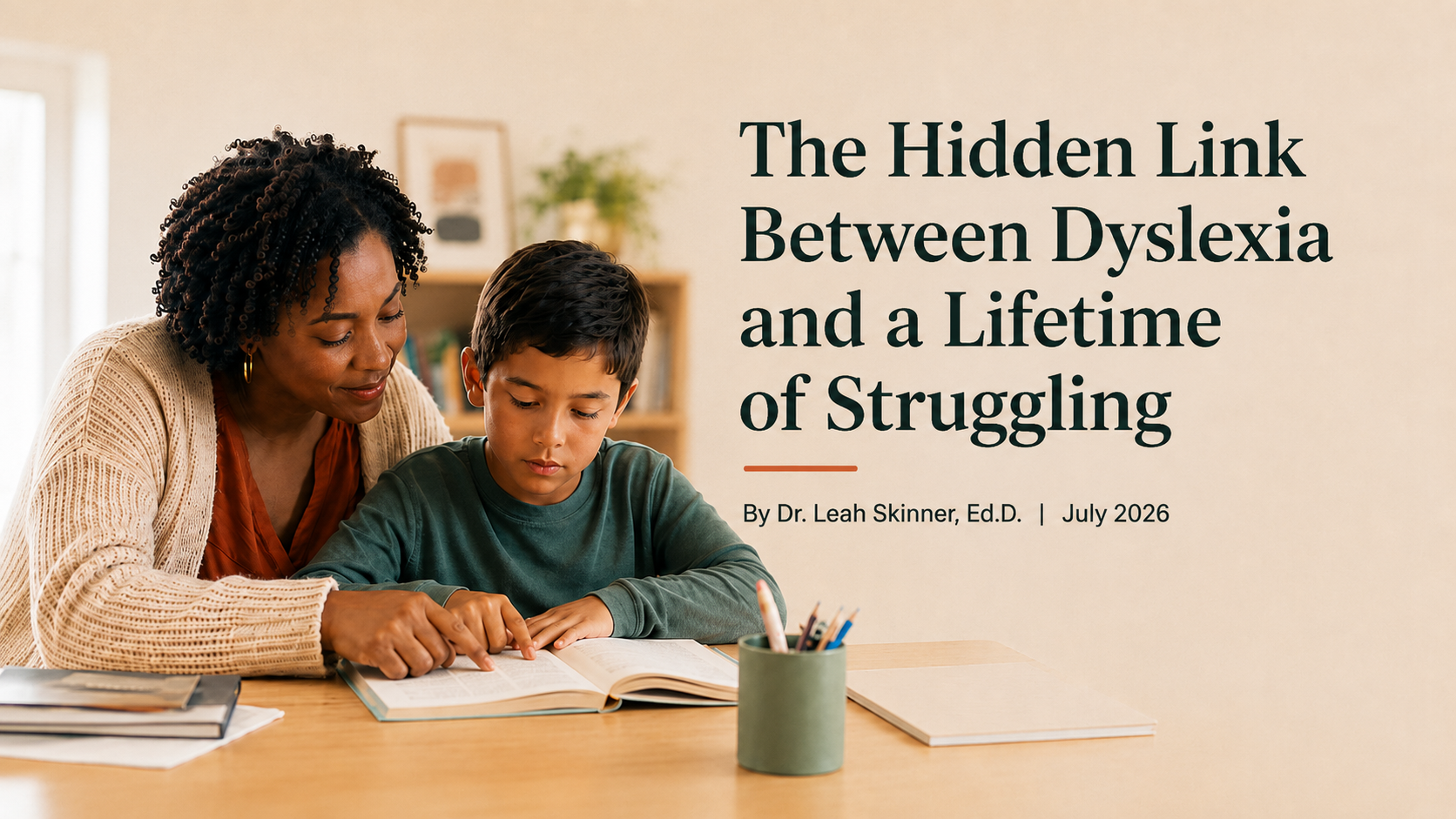
The Hidden Link Between Dyslexia and a Lifetime of Struggling
By Dr. Leah Skinner, Ed.D. | July 2026
Key Takeaway
- The link between dyslexia and a lifetime of struggling is not dyslexia itself. It is what happens when a struggling reader never gets help.
- The numbers are staggering. Over a third of inmates show signs of dyslexia. Third graders who cannot read are four times more likely to drop out of high school.
- Structured Literacy instruction breaks the cycle, restores confidence, and builds lifelong learners. The first step is a conversation about your child.
These numbers stop parents cold, and I watch it happen: a mother reads the incarceration statistic and quietly starts rewriting her child’s future around it. Please do not. In 22 years of clinical work and raising five sons, four of them with dyslexia, I have never once seen the difference come down to ability. It comes down to whether anyone ever taught them the way they learn.
Dr. Leah Skinner, Ed.D., Founder, READ Learning Center
Table of Contents
Untreated Dyslexia Is the Hidden Link, Not Dyslexia Itself
Dyslexia does not cause dropping out. Dyslexia does not cause incarceration. Dyslexia is a difference in how the brain processes written language, and it affects people across every income bracket, neighborhood, and level of intelligence. Some of the most accomplished people alive are dyslexics.
What the statistics actually capture is something else entirely: reading failure that was never addressed. When a child cannot read and no one intervenes, school becomes a place where they fail publicly, every day, in every subject. Frustration turns into avoidance, avoidance into falling behind, falling behind into giving up. Dropout, unemployment, and incarceration are the far end of that chain, not the beginning of it.
Your child will always have dyslexia. Reading failure is optional.
Related Reading
If the school has already said your child does not qualify for help, our guide to the special education gap in Sacramento explains what that answer really means. And if a letter home called your child “at risk for reading difficulties,” we have decoded exactly what that letter is telling you.
Untreated Dyslexia Statistics: Incarceration, Dropout Rates, and Earnings
The numbers are staggering and consistent across decades of research.
Inside Texas prisons
48%
A University of Texas Medical Branch study found 48 percent of Texas inmates showed signs of dyslexia. Twenty years later, an independent Louisiana study confirmed it almost exactly: 47 percent. Even the loosest screening methods find one in three. These were not people who could not learn. They were never taught for a brain wired to learn differently.
Sources: Moody et al., Texas Medicine, 2000; Journal of Correctional Education, 2021
The third grade dropout multiplier
4x
Students who are not reading proficiently by the end of third grade are four times more likely to leave high school without a diploma than proficient readers. For the weakest readers, the gap is wider still.
Source: Hernandez, Double Jeopardy, Annie E. Casey Foundation, 2011
Into adulthood
Lowest literacy, lowest earnings
Federal adult literacy data show that adults at the lowest literacy levels have the lowest rates of full-time employment and the lowest median earnings of any group measured. Reading is not one academic skill among many. It is the skill that others are built on.
Source: National Center for Education Statistics, PIAAC
Keep This In Frame
One in five students has dyslexia. The children behind these statistics were not rare cases. They were ordinary kids with a common learning difference who slipped through without intervention.
Source: Yale Center for Dyslexia & Creativity
Third Grade Reading Proficiency Is the Turning Point
Through third grade, school teaches children to read. From fourth grade on, school assumes they can, and every subject arrives as text.
A child who reaches that shift still unable to decode now has a science problem, a history problem, a math problem, and a growing suspicion that something is wrong with them. Kids do not conclude “I have a phonological processing difference.” They conclude “I’m dumb,” and stop raising their hand. That is the mechanism behind the statistics: not the dyslexia, the years of unaddressed struggle stacked on top of it.
But the turning point only exists where the instruction never changes. Education built for children who learn differently flips that math, with transformative outcomes at almost every age. Third grade is a deadline only for the child who never gets different help.
Signs of Untreated Dyslexia Parents See at Home
Long before it shows up in any statistic, the pattern shows up at home.
- Twenty-minute homework takes two hours, with tears on both sides of the table.
- A bright kid who can explain anything out loud but shuts down the moment reading is involved.
- Stomachaches on school mornings. The slow disappearance of “look what I did today.”
- The sentence that stops a parent cold: “I’m just stupid.”
None of it is a character flaw, and none of it is your parenting. It is what a mismatch between a child’s brain and their instruction looks like from the outside: a child working harder than anyone in their class, without the one thing that makes the work pay off.
Structured Literacy Instruction Breaks the Cycle
The intervention with decades of evidence behind it is called structured literacy. It is the approach underneath programs like Wilson, Barton, and the Orton-Gillingham method, and it does something traditional reading instruction skips. It explicitly teaches the code of the English language, one piece at a time, in a logical order, with enough practice so that each skill becomes automatic before the next is added.
Most children learn to read through traditional classroom instruction. Children with dyslexia learn differently and need to be taught in a way that matches how they learn. Structured Literacy bridges that gap with instruction that leads to meaningful progress.
The National Reading Panel confirmed that explicit, systematic phonics instruction improves reading outcomes. It is the foundation of every credible dyslexia intervention in use today. This is what breaking the cycle looks like: the reading improves, confidence returns, and a child who dreaded books becomes a lifelong learner.
When a child is finally taught the way they learn, everything changes. Not just the reading. The confidence, the willingness to try, the way they carry themselves through a school day.
Getting Answers Starts With a Conversation About Your Child
By the time parents go searching, they have usually been reading the cues for a while. Sometimes a conversation with an expert is all it takes to make sense of them. When you want something concrete, a comprehensive dyslexia assessment shows exactly where reading is breaking down. Either way, the destination is the same: Structured Literacy instruction from trained specialists, with progress you can measure.
The difference between the statistics and the success stories is simple: someone figured out what was going on and taught the child the way they learn.
Sources
- Moody, K.C., et al. Prevalence of dyslexia among Texas prison inmates. Texas Medicine, 2000
- Dyslexia in Incarcerated Men and Women: A New Perspective on Reading Disability in the Prison Population. Journal of Correctional Education, 2021
- Hernandez, D. Double Jeopardy: How Third-Grade Reading Skills and Poverty Influence High School Graduation. Annie E. Casey Foundation, 2011
- Yale Center for Dyslexia & Creativity
- National Center for Education Statistics, adult literacy, employment, and earnings data (PIAAC)
- National Reading Panel, Teaching Children to Read, NICHD, 2000
Questions Parents Ask
What happens if dyslexia is not treated?
The reading gap compounds. After third grade, every subject arrives as text, so a decoding problem becomes a science, history, and math problem, and repeated failure erodes self-esteem until many children stop trying. Untreated reading difficulty is associated with a sharply higher dropout risk and lower lifetime earnings. None of it is inevitable: with Structured Literacy instruction, children with dyslexia learn to read at any age.
Are people with dyslexia more likely to end up in prison?
Dyslexia is heavily overrepresented in prison populations. The two most rigorous studies, in Texas and Louisiana, each found nearly half of inmates showed signs of dyslexia, and even loose screening studies land around one in three. The driver is not dyslexia itself. It is reading failure that was never addressed, which is why intervention changes the trajectory.
Can dyslexia be cured?
No. Dyslexia is a lifelong difference in how the brain processes written language, and children do not outgrow it. But reading failure is treatable: Structured Literacy instruction, the explicit, systematic approach behind programs like Wilson, Barton, and the Orton-Gillingham method, teaches children with dyslexia to decode, spell, read fluently, and understand what they have read. Decades of research support it.
How do I know if my child has dyslexia?
Common signs include trouble sounding out words, persistent spelling difficulty, slow effortful reading despite strong spoken language, avoidance of reading, and a family history of reading struggles. It is confirmed through a comprehensive evaluation that measures phonological awareness, decoding, fluency, and spelling. Parents can request an evaluation from their school district in writing, or pursue a private evaluation for a faster, more detailed picture.
Is it too late to help my child with dyslexia?
No. Earlier intervention works faster and protects self-esteem, but Structured Literacy can work at any age because it teaches the language’s code directly. Older students often move quickly once instruction finally matches how they learn. The only wrong time to start is later.
Change begins with a conversation.
Dr. Leah Skinner has spent more than 22 years advocating for children with dyslexia and helping Sacramento families find out exactly what is going on and what to do about it. Bring what you have noticed at homework time, and one conversation will tell you more than another night of searching. READ Learning Center. We teach children to read.
(916) 234-5880 | 2565 Millcreek Dr Suite B, Sacramento, CA 95833

Founder, READ Learning Center & READ Academy of Sacramento | Certified Dyslexia Therapist
Dr. Leah Skinner holds a Doctor of Education in Reading, Literacy and Assessment, a Master of Education with a specialization in dyslexia, and is a Certified Dyslexia Therapist and Special Education Advocate with over 22 years of experience. As the founder of READ Learning Center and READ Academy of Sacramento and a mother of five neurodivergent sons, four of whom have dyslexia, she brings both clinical expertise and personal understanding to every family she works with. She opened READ Academy in 2020 to bring specialized, evidence-based instruction to a larger community in Sacramento.Watch: The Hidden Link
Thirty seconds is enough to see the whole pattern: what the statistics actually measure, and what changes when a struggling reader is finally taught the way they learn.

Chapters
- 00:06 — Understanding Dyslexia
- 00:38 — Dyslexia vs. Reading Failure
- 01:08 — When Reading Struggles Go Untreated
- 01:42 — Dyslexia and Incarceration
- 02:15 — Dropout Rates & Lifelong Impact
- 02:46 — Why Reading Skills Matter
- 03:16 — Where the Education System Fails
- 03:49 — The Emotional Impact of Dyslexia
- 04:52 — Structured Literacy Works
- 06:10 — Teaching Children the Right Way
When a child is taught the way they learn, everything changes.
Structured Literacy breaks the cycle, restores confidence, and builds lifelong learners. READ Learning Center was built for children who learn differently, and if you are ready to find the right fit for your child, it all begins with a conversation. We teach children to read.
Listen: The Hidden Link
Listen as we walk through the research on untreated dyslexia, why the statistics say less about your child than they seem to, and the intervention that changes the ending.
The Hidden Link Between Dyslexia and a Lifetime of Struggling
READ Learning Center
In This Episode
- 0:00 — Understanding Dyslexia
- 00:21 — Dyslexia vs. Reading Failure
- 00:40 — When Reading Struggles Go Untreated
- 01:03 — Dyslexia and Incarceration
- 01:25 — Dropout Rates & Lifelong Impact
- 01:45 — Why Reading Skills Matter
- 02:06 — Where the Education System Fails
- 02:25 — The Emotional Impact of Dyslexia
- 03:07 — Structured Literacy Works
- 03:59 — Teaching Children the Right Way
Transcript
Untreated dyslexia is the hidden link.
There is a link between dyslexia and a lifetime of struggling, and most parents are never shown it. It is not the dyslexia itself. It is what happens when a struggling reader goes without help.
The numbers are staggering, ranging from third-grade reading scores to dropout rates, earnings, and prison literacy studies. Every one of those statistics describes what happens to a struggling reader who never gets taught the way they learn.
Dyslexia does not cause dropping out. Dyslexia does not cause incarceration. Dyslexia is a difference in how the brain processes written language, and it affects people across every income bracket, neighborhood, and level of intelligence.
Some of the most accomplished people alive are dyslexics.
What the statistics actually capture is something else entirely: reading failure that was never addressed.
Your child will always have dyslexia. Reading failure is optional.
Untreated dyslexia statistics.
Studies of prison populations repeatedly find that more than a third of all inmates show signs of dyslexia. The strongest studies put it even higher.
A University of Texas Medical Branch study found 48 percent of Texas inmates showed signs of dyslexia, and twenty years later an independent Louisiana study confirmed it almost exactly, at 47 percent.
These were not people who could not learn. They were never taught for a brain wired to learn differently.
And students who are not reading proficiently by the end of third grade are four times more likely to leave high school without a diploma.
The pattern follows people into adulthood.
Lowest literacy, lowest earnings: adults at the lowest literacy levels have the lowest rates of full-time employment and the lowest median earnings of any group measured.
One in five students has dyslexia. The children behind these statistics were not rare cases. They were ordinary kids with a common learning difference who slipped through without intervention.
Third grade reading proficiency is the turning point.
Through third grade, school teaches children to read. From fourth grade on, school assumes they can, and every subject arrives as text.
A child who reaches that shift still unable to decode now has a science problem, a history problem, a math problem, and a growing suspicion that something is wrong with them.
Kids do not conclude they have a phonological processing difference. They conclude they are dumb, and stop raising their hand.
That is the mechanism behind the statistics. Not the dyslexia. The years of unaddressed struggle stacked on top of it.
But the turning point only exists where the instruction never changes.
Education built for children who learn differently flips that math, with transformative outcomes at almost every age.
Third grade is a deadline only for the child who never gets different help.
Signs of untreated dyslexia at home.
Long before it shows up in any statistic, the pattern shows up at home.
Twenty-minute homework takes two hours, with tears on both sides of the table.
A bright kid who can explain anything out loud but shuts down the moment reading is involved.
Stomachaches on school mornings.
And the sentence that stops a parent cold: “I’m just stupid.”
None of it is a character flaw, and none of it is your parenting.
It is what a mismatch between a child’s brain and their instruction looks like from the outside.
Structured Literacy instruction breaks the cycle.
The intervention with decades of evidence behind it is called Structured Literacy.
It is the approach underneath programs like Wilson, Barton, and Orton-Gillingham.
It teaches the code of the English language explicitly, one piece at a time, in a logical order, with enough practice that each skill becomes automatic before the next one is added.
Most children learn to read through traditional classroom instruction. Children with dyslexia learn differently and need to be taught in a way that matches how they learn.
Structured Literacy bridges that gap with instruction that leads to meaningful progress.
Structured Literacy breaks the cycle, restores confidence, and builds lifelong learners.
When a child is finally taught the way they learn, everything changes. Not just the reading. The confidence, the willingness to try, the way they carry themselves through a school day.
Getting answers starts with a conversation about your child.
By the time parents go searching, they have usually been reading the cues for a while.
Sometimes a conversation with an expert is all it takes to make sense of them.
When you want something concrete, a comprehensive dyslexia assessment shows exactly where reading is breaking down.
Either way, the destination is the same: Structured Literacy instruction from trained specialists, with progress you can measure.
The difference between the statistics and the success stories is simple.
Someone figured out what was going on and taught the child the way they learn.
Does this sound familiar?
If any part of this sounds familiar, maybe it’s time to start a new conversation.