
READ Learning Center
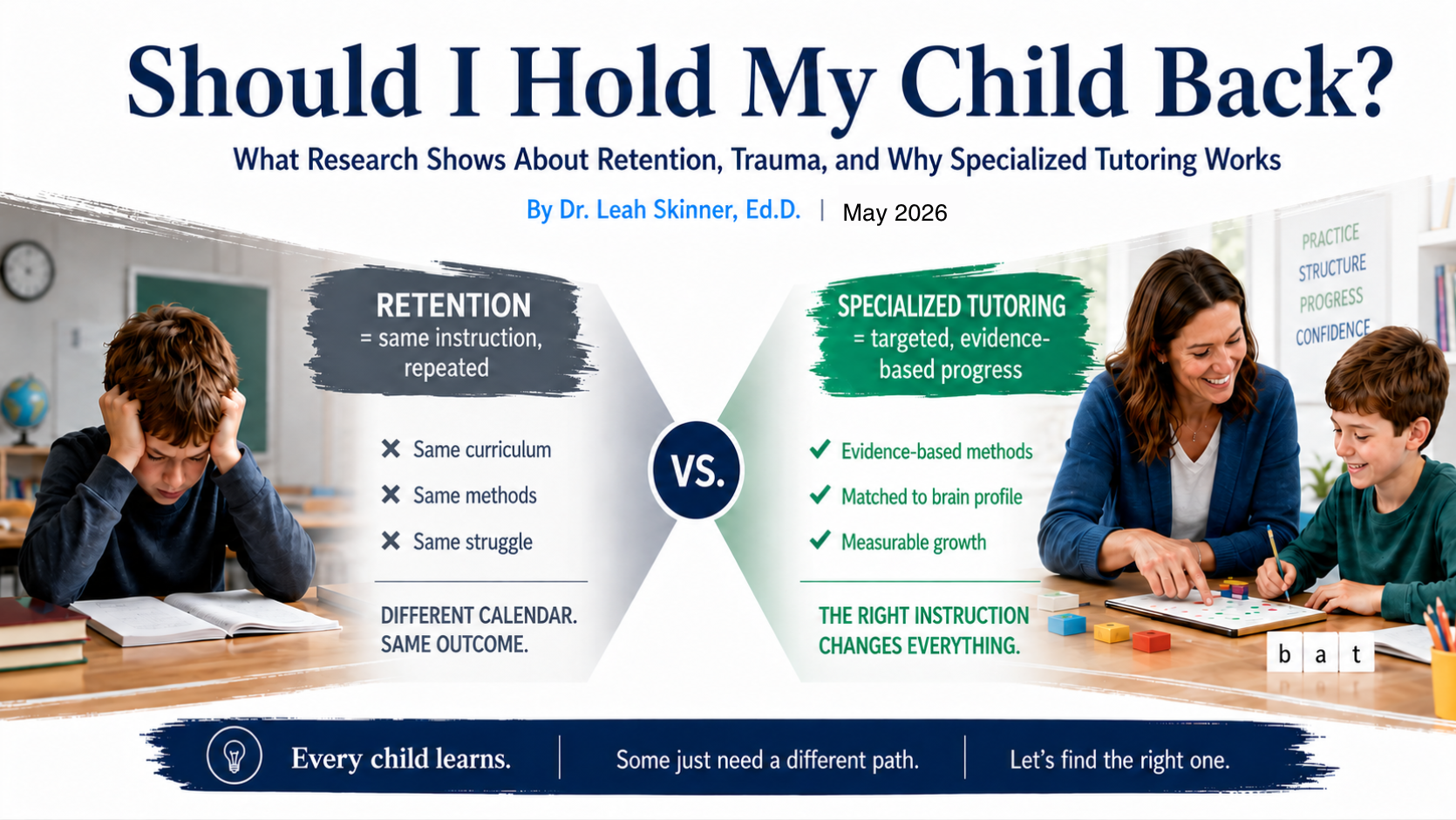
Should I Hold My Child Back?
By Dr. Leah Skinner, Ed.D. | April 2026
Key Takeaway
Before you consider holding your child back a year, read this. Retention does not fix a learning difference. It repeats the same broken instruction with a new calendar. The research is clear: the right specialized tutoring, matched to your child’s profile, closes the gap most parents are never told it can close. Months of evidence-based instruction can save years of trauma.
Table of Contents
Hold Them Back. Give Them Another Chance.
That is the recommendation most IEP teams give when a child with a learning difference is not making progress. The room goes quiet when it lands. The parents agree because the recommendation comes from the experts and sounds reasonable.
It is not reasonable. Repeating a year is the same nine months of the same instruction the child already could not learn from.
After more than twenty years of clinical practice, and four sons of my own with dyslexia, I have watched parents accept this recommendation dozens of times. The retention year delivers exactly what the research predicts: more frustration, more stress, no progress. The recommendation that sounds reasonable in the meeting room produces the outcome the room was trying to avoid.
Why Repeating the Year Does Not Work
Retention is built on the assumption that the problem is exposure. Not enough time, not enough practice, not enough effort. For children with learning differences, that is rarely the problem. The problem is the method.
Reading instruction that does not include explicit, systematic phonics will not teach a child with dyslexia to read no matter how many times it is repeated. Math instruction that skips the multisensory foundation will not build number sense in a child with dyscalculia. Writing instruction that asks a child with dysgraphia to try harder will not address the motor planning and orthographic processing that is breaking down. The same is true for ADHD and executive function. The classroom is delivering instruction that does not match the way these children’s brains actually learn.
When a child works hard for nine months and the instruction was not designed for the way they learn, asking them to do the same nine months again, harder, is not a plan.
“If the instruction did not work the first time, repeating the year does not change the instruction.”
Dr. Leah Skinner, Ed.D., READ Learning Center
The cost is documented. New York City students who were retained dropped out at higher rates, took fewer core exams, and graduated with fewer credits (Mariano et al., 2025). The conversation in the meeting room rarely names any of this.
What Specialized Tutoring Can Do That Retention Cannot
Retention gives your child the same broken instruction, again. Specialized tutoring gives them the right instruction, finally.
This is not homework help. Homework help adjusts assignments. It does not change the way the child’s brain is being taught. Specialized tutoring does. It identifies how the child’s brain processes language, numbers, or writing, and matches the instruction to that profile.
Forty years of reading intervention research, synthesized in a 2023 meta-analysis, found a positive effect of targeted intervention on reading outcomes (g = 0.33), with higher dosage producing larger effects (Hall et al., 2023, Reading Research Quarterly). Translation: the more hours of the right instruction, the bigger the gain. A year of school is roughly 1,000 instructional hours. For a child with a learning difference, those hours produced no progress because the method did not fit. Specialized tutoring delivered in two to four sessions per week, with the right methodology, produces measurable change in months, not years.
What Specialized Tutoring Actually Means
The word “tutor” covers a lot of ground. Most of it is not what your child needs.
Most tutors are college students or retired teachers who help with homework and test prep. They are competent. They are warm. They are not trained to deliver evidence-based intervention for a learning difference. Most have never heard of Wilson Reading System, Making Math Real, the Orton-Gillingham approach, or the Institute for Excellence in Writing.
Specialized tutoring is different. The instructors have been trained in the specific methodology your child needs. They have delivered it across hundreds of hours with many children before they sit across from yours. That is what makes the hours count.
For a dyslexic child, that means structured literacy, taught in sequence, using Orton-Gillingham or a research-aligned program like Wilson. For a child with dyscalculia, it means multisensory math built around number sense. For a child with dysgraphia, it means direct instruction in letter formation, orthographic patterns, sentence structure, and paragraph organization. For a child with ADHD, it means scaffolds that support self-management while content is delivered in a way that fits their attention regulation.
Homework Tutoring vs Specialized Tutoring
What most families try first when their child is struggling.
- Delivered by college students or retired teachers
- Teaches whatever this week’s assignments are
- No specific methodology
- Variable schedule, no measurement plan
- Tonight’s homework done, the gap unchanged
What evidence-based remediation actually delivers.
- Delivered by Wilson Level I or II, an AOGPE (Academy of Orton-Gillingham Practitioners and Educators) practitioner, or a Certified Dyslexia Therapist
- Targeted intervention matched to the brain’s specific gap
- Uses Orton-Gillingham, Wilson Reading System, or Making Math Real
- Two to four sessions per week, measured against intake
- Measurable progress toward grade level, increased confidence and comprehension
Both call themselves tutoring. Only one closes the gap that retention is meant to fix.
What the Research Documents
Three findings the research is clear about. Three findings the IEP team rarely names.
- Hours matter.Forty years of reading intervention research, synthesized in a 2023 meta-analysis, found that larger doses of targeted intervention produce larger gains (g = 0.33). Hall et al., 2023, Reading Research Quarterly
- Mental health cost.Dyslexic primary school students show depression symptoms at 36.5% and anxiety symptoms at 26.3%. Retention adds another year of mismatched instruction on top of these baseline rates. Feng, Chotipanvithayakul, & Liu, 2024, Australian Journal of Psychology
- Targeted intervention works.A 2025 meta-analysis of school-based randomized controlled trials for ADHD found targeted interventions improved core symptoms, academic performance, and social skills. Yegencik, Bell, & Deniz, 2025, Frontiers in Psychology
When Tutoring Is the Right Move (and When It Is Not)
Specialized tutoring is the right move when the school environment is otherwise functional and the gap is instruction-specific. Most children who are recommended for retention fall into this category. The classroom culture is fine. The peer relationships are fine. What is broken is the specific instructional ingredient the child’s brain needs and is not getting.
When the whole environment is broken, when peer dynamics or accumulated frustration have turned the school day itself into a stressor, full-time placement at a school built specifically for these brains may be the better path. For families considering that path, our sister school, READ Academy of Sacramento, is built specifically for children with dyslexia and language-based learning differences.
Tutoring is not the answer for every child. It is the answer for most.
What the First Six Months Look Like
Specialized remediation starts with what the child can do, what they cannot, and where instruction has been breaking down. Sessions run two to four times per week, one to one, with an experienced instructor delivering structured, sequential lessons matched to your child’s specific learning profile. Progress is measured against where the child started, not where their grade-level peers are.
For families who want a deeper diagnostic before they begin, READ Learning Center offers a comprehensive assessment that identifies the exact profile driving your child’s struggles. The assessment is optional. Many families start tutoring directly and let the first sessions build the diagnostic picture in real time.
By month three, parents start seeing change at home. Homework gets done with less battle. The child volunteers what they are working on instead of hiding it. The “I can’t” that used to fill the dinner table starts to loosen. By month six, the gap that the school flagged for retention is closing. The year that was going to be repeated becomes the year that finally moves forward.
Before You Sign the Retention Paperwork
Ask the school what specifically will be different about the second year. The same method cannot produce a different outcome. Retention is a placement decision that requires your consent. You have the right to say no. Call us at (916) 234-5880 or contact us. We can talk through whether specialized tutoring is the right move for your child.
Sources
- Mariano, L. T., Martorell, P., & Berglund, T. (2025). The Effects of Grade Retention on High School Outcomes: Evidence from New York City Schools. Journal of Research on Educational Effectiveness, 18(1), 1-31.
- Hall, C., Dahl-Leonard, K., Cho, E., Solari, E. J., Capin, P., Conner, C. L., Henry, A. R., Cook, L., Hayes, L., Vargas, I., Richmond, C. L., & Kehoe, K. F. (2023). Forty Years of Reading Intervention Research for Elementary Students with or at Risk for Dyslexia: A Systematic Review and Meta-Analysis. Reading Research Quarterly, 58(2), 285-312.
- Feng, W., Chotipanvithayakul, R., & Liu, H. (2024). Prevalence of dyslexia related to mental health problems and character strengths among primary school students in northwest China. Australian Journal of Psychology, 76(1), 2399114.
- Yegencik, B., Bell, B. T., & Deniz, E. (2025). School-based randomized controlled trials for ADHD and accompanying impairments: a systematic review and meta-analysis. Frontiers in Psychology, 16, 1611145.

Dr. Leah Skinner walks through what the research actually shows about retention, why repeating a year does not fix a learning difference, and what specialized tutoring delivers that another year of the same classroom cannot.
Chapters
- 0:00 — Why we have to talk about retention
- 0:50 — The IEP meeting where the only plan is the same year over again
- 1:45 — Why repeating the year does not work
- 3:00 — What specialized tutoring delivers that retention cannot
- 4:30 — What "specialized" actually means (Wilson, Orton-Gillingham, AOGPE)
- 6:00 — What the first six months look like
Should I Hold My Child Back?
with Dr. Leah Skinner, Ed.D., READ Learning Center
An extended audio walk-through of the research, what is happening inside a child during a retention year, and exactly what specialized tutoring delivers that another year of the same classroom cannot.
Chapters
- 0:00 — Introduction and key takeaway
- 0:33 — Hold them back, give them another chance
- 1:22 — Why repeating the year does not work
- 2:43 — What specialized tutoring can do that retention cannot
- 3:50 — What specialized tutoring actually means
- 5:01 — Homework tutoring vs specialized tutoring
- 5:54 — What the research documents
- 6:55 — When tutoring is the right move (and when it is not)
- 7:48 — What the first six months look like
- 8:56 — Before you sign the retention paperwork
Replace the Year That Did Not Work
READ Learning Center is Sacramento’s specialized tutoring center for children with dyslexia, dysgraphia, dyscalculia, ADHD, and executive function differences. We work with families from public school, private school, and homeschool. The goal is always the same: deliver the instruction your child’s brain actually needs.
Frequently Asked Questions
If I say no to holding my child back, will tutoring really be enough to catch them up?
Yes, for most children with learning differences. Retention repeats the instruction that did not work. Specialized tutoring delivers instruction that does. When the gap is instructional rather than environmental, the right tutoring closes it without requiring your child to lose a year of school with their peers.
How many hours per week, and for how long, before we see results?
Two to four sessions per week is the typical commitment. Most parents see early signs of progress within twelve weeks: more willingness to read aloud, less avoidance of homework, less anxiety around academic tasks. Measurable gain on standardized assessments typically takes six to twelve months of consistent intervention.
We already tried a tutor and it did not work. Why would this be different?
Most tutoring is homework help. It adjusts the assignments your child brings home but does not change how the material is being taught. Specialized tutoring is different. Trained instructors deliver an evidence-based methodology, such as Orton-Gillingham, Wilson Reading System, Making Math Real, or the Institute for Excellence in Writing, designed for how your child’s brain processes information. The tutoring you tried before likely was not specialized in this way.
Can my child stay in their current school and still close the gap?
Yes. Specialized tutoring works alongside the regular school day. Your child stays with their friends, stays in their classroom, and gets the targeted instruction outside of school hours. The gap closes without your child losing the rest of the experience.
The school is strongly pushing retention. How do I say no in the IEP meeting?
Retention is a placement decision. You have the legal right to say no. You can ask the team to reconvene and revise the plan with specific evidence-based interventions, request an Independent Educational Evaluation (IEE) if you disagree with the school’s evaluation, or refuse to sign the retention paperwork. As a Special Education Advocate, I have walked dozens of families through these meetings. Saying no is harder than saying yes, but it is your right and often the better call.
What if specialized tutoring still does not work?
For most children, the right specialized tutoring closes the gap. When it does not, the issue is rarely the tutoring itself. It usually means the whole school environment has become a stressor: peer dynamics, classroom culture, or accumulated frustration are larger forces than the specific academic gap. When that is the case, full-time placement at a school built for children with learning differences is the better path. Our sister school READ Academy of Sacramento was built specifically for these students.
